These concluding lines are really what Postman has been trying to say. He says that people aren't just "laughing instead of thinking," they really have no idea why they're doing that. People have taken entertainment for granted and everything has to entertain them. Now, people don't even know what they're laughing about or why they seek entertainment. They just know that without it, life seems boring. Because of this way of thinking, Postman tries to say that people are losing their ability to think. Now they not only search for entertainment, but they also have no clue that they are slowly letting their ability to think disappear. People don't even realize it. They've stopped thinking and they don't know why. This is what Postman has been saying throughout his book. People have forgotten what thinking means and replaced thinking with forms of entertainment. Except, now this entertainment is all that people know. They no longer want to think. People only want to be entertained."For in the end, he was trying to tell us that what afflicted the people in Brave New World was not that they were laughing instead of thinking, but that they did not know what they were laughing about and why they had stopped thinking."
Tuesday, February 22, 2011
Amusing Ourselves to Death

Sunday, February 6, 2011
Silence Is Not So Golden...
Friday was a very hard day to get through. Communicate only with actions and doodles; NO TALKING. I found myself several times wanting to say something, realizing I can't say it, and getting all frustrated trying to explain myself through terrible pictures and even worse charades skills. The whole day was hilarious trying to get people to understand me and trying to understand other people. I slipped up for such a simple thing, when someone asked me what time class got out. Eleven o' nine slips out of my mouth before I even realized what I was doing.
Lunch was the best part. Basically our whole table was silent, except for our laughter while we tried to figure out what someone was trying to say. I was trying to ask my friends who was going to Sadie's, so I drew what I thought was a pretty good stick figure interpretation of what a dance would look like. I drew a pathetic disco ball and stick people with little lines around them, in an attempt to show that they were dancing. Then I put a big question mark over it, because I was trying to ask a question. I showed them and they gave me blank looks followed by laughter at my picture. I tried to save myself by adding musical notes around the people to get the idea that music was playing. Finally, someone next to us who could talk started guessing random things. They still were not getting the idea. I gave up with my drawings and tried to act out dancing in my seat. Everyone roared with laughter as I boogied in my seat trying to get them to understand I was DANCING! Once everyone, including myself, began to breathe again, they finally figured it out after they had some help with a lucky soul who could talk.
Postman was very right in saying that smoke signals don't help that much. Like my drawings, unless you had a system or code worked out, it was very hard to communicate with people. I would imagine smoke signals had their flaws as well, because there are no words to help explain what the signal means. He is right in saying that words are very important. Without words, ideas and thoughts are very complicated to try and explain to people.
 |
| Silence is NOT always "Golden." |
Lunch was the best part. Basically our whole table was silent, except for our laughter while we tried to figure out what someone was trying to say. I was trying to ask my friends who was going to Sadie's, so I drew what I thought was a pretty good stick figure interpretation of what a dance would look like. I drew a pathetic disco ball and stick people with little lines around them, in an attempt to show that they were dancing. Then I put a big question mark over it, because I was trying to ask a question. I showed them and they gave me blank looks followed by laughter at my picture. I tried to save myself by adding musical notes around the people to get the idea that music was playing. Finally, someone next to us who could talk started guessing random things. They still were not getting the idea. I gave up with my drawings and tried to act out dancing in my seat. Everyone roared with laughter as I boogied in my seat trying to get them to understand I was DANCING! Once everyone, including myself, began to breathe again, they finally figured it out after they had some help with a lucky soul who could talk.
Postman was very right in saying that smoke signals don't help that much. Like my drawings, unless you had a system or code worked out, it was very hard to communicate with people. I would imagine smoke signals had their flaws as well, because there are no words to help explain what the signal means. He is right in saying that words are very important. Without words, ideas and thoughts are very complicated to try and explain to people.
Friday, February 4, 2011
Technology and Society
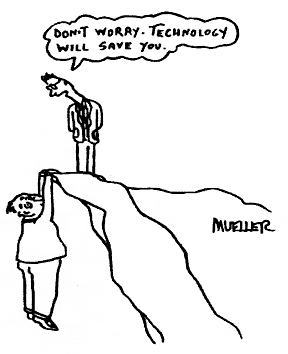 Postman discusses in both his book and his speech, that society is slowly changing through the years and it is changing for the worst, in his opinion. People are depending more and more on electronics and technologies than with other people. In his book Amusing Ourselves to Death, he talks about how the human race continues to create new ideas. We continue to try and make things better, faster, or easier. Technologies keep growing, such as the smoke signals he mentions. People used to communicate in smoke signals. Anything that was left out of the smoke signal would have to be verbalized to the person, so smoke signals only communicated basic ideas. Throughout the years, people improved this greatly. They created the telephone, and now we have cell phones and social networks. People continue to depend on technology now. In his speech, he talks about people becoming more comfortable with talking to machines rather than talking with people, like the answering machine. Slowly society becomes more dependent on machines and other technology rather than on people. He says that eventually people may end up talking to things such as door nobs or toasters, but that would be ok.
 Thursday, January 27, 2011
Civility Not Censorship
In the first six words of her column, Linda Chavez states that she believes that it is important to remain polite when speaking out in public. She brings up "bellicose" metaphors, or metaphors that have to do with war, because these phrases, such as "campaign," "rounds," and "took his best shot," all have to do with war and yet they are being used to describe politics.
She's making the point that we take these words and turn them into something else. Chavez is trying to say that we should think before we speak, but our choice of words doesn't have to be boring. She says that the words themselves don't really matter; it's the meaning behind them that counts. She uses words like "Indian" and "Native American" or "ghetto" and "urban" as examples. Linda Chavez also brings up the new edition of "Huckleberry Finn," where they replaced "nigger" with slave. Her best example was explaining the words "gay" and "queer." These words used to have different definitions than what we think of them as today. "Gay" meant happy and "queer" just meant odd or peculiar. Now they refer to "sexual orientation" and homosexuals.
I agree, because people today are so afraid of offending someone else because of a word they use. That's not necessarily a bad thing, but people blow it way out of proportion, such as the "nigger" and "slave" switch in Huckleberry Finn.
She's making the point that we take these words and turn them into something else. Chavez is trying to say that we should think before we speak, but our choice of words doesn't have to be boring. She says that the words themselves don't really matter; it's the meaning behind them that counts. She uses words like "Indian" and "Native American" or "ghetto" and "urban" as examples. Linda Chavez also brings up the new edition of "Huckleberry Finn," where they replaced "nigger" with slave. Her best example was explaining the words "gay" and "queer." These words used to have different definitions than what we think of them as today. "Gay" meant happy and "queer" just meant odd or peculiar. Now they refer to "sexual orientation" and homosexuals.
I agree, because people today are so afraid of offending someone else because of a word they use. That's not necessarily a bad thing, but people blow it way out of proportion, such as the "nigger" and "slave" switch in Huckleberry Finn.
Monday, December 20, 2010
Conserve, Reuse, Recycle

"Have you figured out yet that I'm going as
a cadaver, an anatomical gift?"
Semrau purposely leaves information out. I think he does this to really capture the reader's attention. His intent is to make it sound like he's really going green, but in reality, he wants his body to be donated. Throughout most of the article, he's talking about how going green can be a good thing. He says, however, that he prefers to reuse, instead of conserve or recycle. He is, of course, referring to reusing his body, but the reader does not know that yet.
I think his writing strategy was pretty effective. It definitely caught my attention and made me think about everything he said a little differently. If he just said from the very beginning that he planned on becoming a cadaver, sure it would have been a lot easier to understand right away, but it also would not have held my interest, or make me really think about what he's going to do. Sharing this and not telling the reader right away what he's talking about, gets the reader interested in what he has to say. It caught their attention that he was not talking about what they thought he was. It worked for me anyway!
Wednesday, December 8, 2010
Savior of the Nations, Come
 In this hymn, Luther is talking about Jesus Christ's birth and how we should praise him. He uses diction to help us better understand his theme, which would be that Jesus is God, who came down from heaven as man, and we should praise him. In the first and second verses he talks about Jesus being born of the Virgin Mary and coming to earth as man. He uses the words "flesh and blood" to describe Christ as being true man. In verses three, four, and five, he goes on to talk about how the world "disowned" him, but he was still "enthroned" in heaven. Then he rose from the dead with "victory" over sin. Luther says that his song of "triumph swells". He also says that his kingdom will be "boundless" and we are waiting to see its "glories". This shows that he was also true God, because only true God can die and raise again to save man from their sins. The last two verses are more about us and our response to what Jesus did for us. He says we should have faith in him and keep our faith "bright," and that we should praise the Father, Son, and Holy Spirit.
Thursday, December 2, 2010
Sermon Diagnostic
1) 26 verbs
- makes holy
- slain (3 times)
- is lamb
- died (4 times)
- lives (2 times)
- rose (2 times)
- reins (3 times)
- makes us alive
- is there
- smiles (2 times)
Subscribe to:
Posts (Atom)